The Complete Guide to Trading Journal Entries That Actually Improve Performance
Learn how to write journal entries that go beyond basic trade logs to capture the psychological insights that separate winning traders from the rest.
Tradris Team
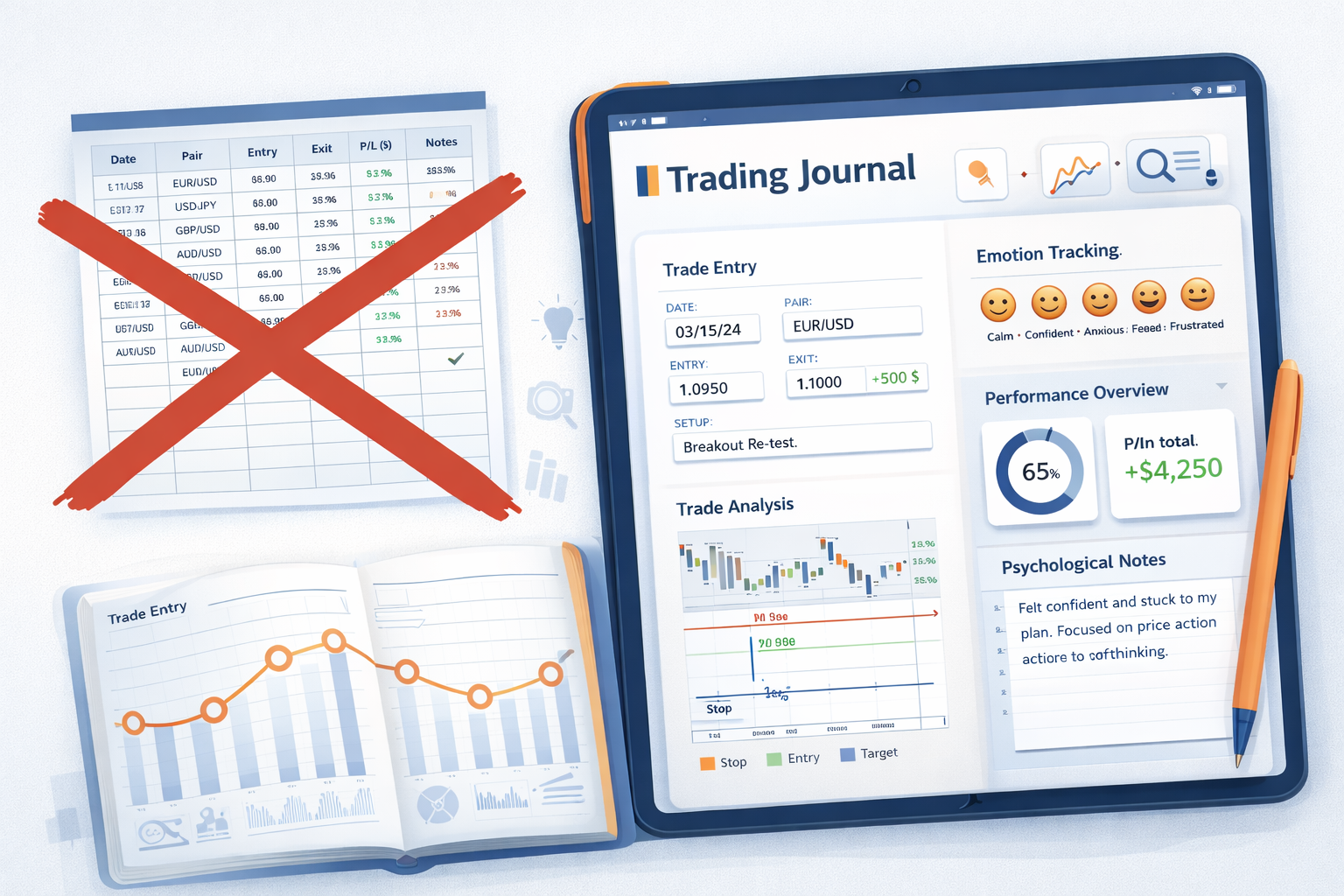
The Complete Guide to Trading Journal Entries That Actually Improve Performance
Most trading journals are just glorified spreadsheets. Here's how to create entries that actually transform your trading psychology and performance.
Why Most Trading Journals Fail
Traditional trading journals focus on the wrong metrics:
- ❌ Entry price, exit price, P&L
- ❌ Technical setup descriptions
- ❌ Market conditions at entry
While these are useful, they miss the most important element: your psychological state and decision-making process.
The Psychology-First Journal Framework
Effective journal entries capture three critical elements:
1. Pre-Trade Psychology
What to capture:
- Your emotional state before entering
- Confidence level (1-10 scale)
- External factors affecting your mindset
- Why you believe this trade will work
Example entry:
"Feeling confident (8/10) after yesterday's winner. Nifty gapping up, feeling FOMO pressure. Taking this pullback setup because it matches my framework perfectly. Risk management: 2% as planned. No external stress today."
2. In-Trade Management
What to capture:
- Emotional changes during the trade
- Temptations to deviate from your plan
- Market events that tested your conviction
- How you handled drawdowns or profits
Example entry:
"Trade moved against me immediately. Felt urge to exit early at -0.5R but stuck to plan. When it hit +1R, almost took full profit due to fear of giving it back. Reminded myself of framework rules and took partial as planned."
3. Post-Trade Analysis
What to capture:
- What you learned about yourself
- Emotional patterns you noticed
- What you'd do differently (process, not outcome)
- How this trade fits your long-term development
Example entry:
"Realized I still struggle with fear when trades move in my favor. Need to work on profit-taking discipline. The setup worked exactly as expected - validates my framework. Next time, will set alerts instead of watching every tick."
The Tradris Journal Template
Use this structure for every trade:
Pre-Trade Section
- Date/Time: ___________
- Market Conditions: ___________
- Emotional State (1-10): ___________
- Confidence Level (1-10): ___________
- External Factors: ___________
- Setup Description:
- Why I'm taking this trade:
- Risk Management Plan:
During Trade Section
- Emotional Changes:
- Temptations to Deviate:
- How I Handled Pressure:
Post-Trade Section
- What I Learned:
- Emotional Patterns Noticed:
- Process Improvements:
- Framework Validation:
Advanced Journaling Techniques
The "Future Self" Letter
Write a letter to yourself explaining your trade decision as if you're teaching a student. This forces clarity and reveals flawed reasoning.
Emotional Intensity Tracking
Rate the intensity of key emotions (1-10):
- Fear: ___
- Greed: ___
- Confidence: ___
- Frustration: ___
- Excitement: ___
The "What If" Analysis
Explore alternative scenarios:
- "What if this trade goes against me?"
- "What if I'm wrong about market direction?"
- "What if I exit too early again?"
Where do you actually score?
Before you read further — if you want a structured read on the same patterns from the inside, take the free Readiness Quiz: 11 questions, ~3 minutes, no email gate to start.
It scores you across 5 dimensions that predict trading profitability and surfaces the one dimension to fix first.
Free. No login. Used by 3,200+ Indian traders.
<!-- BLOG_HUB_CTA -->Or browse all six free Psychology Assessments — Readiness, Trader DNA, Bias Profile, Financial Readiness, Motivation, and Trading Style.
Common Journaling Mistakes
Mistake 1: Outcome Bias
Wrong: "Bad trade because I lost money" Right: "Good process execution despite unfavorable outcome"
Mistake 2: Vague Emotions
Wrong: "Felt nervous" Right: "Felt nervous (7/10) due to position size being larger than usual, which made me question my stop-loss placement"
Mistake 3: Technical Focus Only
Wrong: "RSI was oversold, MACD divergence" Right: "Saw RSI oversold + MACD divergence. Felt confident because pattern matched my backtested setup. Worried about news event tomorrow but decided setup was too good to pass up."
The Weekly Journal Review
Every week, review your entries for patterns:
Emotional Patterns
- Which emotions led to your best trades?
- Which emotions preceded your worst decisions?
- Are you improving at managing fear/greed?
Decision Quality
- Are you following your framework consistently?
- What external factors most affect your judgment?
- Where are you still making discretionary overrides?
Performance Correlation
- Do confident trades perform better?
- Is there a correlation between emotional state and outcomes?
- Which setups align best with your psychology?
Sample High-Quality Journal Entry
Date: January 15, 2025, 10:30 AM Trade: Long Nifty at 24,850
Pre-Trade Psychology: Emotional state: 7/10 (calm, focused) Confidence: 8/10 (setup matches backtested pattern) External factors: Good night's sleep, no personal stress Market conditions: Uptrend intact, pullback to 20-day MA
Why I'm taking this trade: Perfect pullback setup after 3-day rally. Volume declining on pullback (healthy). RSI reset to 45 from overbought. This exact pattern has 68% win rate in my backtests.
Risk Management: Risking 2% (₹20,000 on ₹10 lakh account) Stop: 24,800 (50 points = ₹20,000 risk) Target 1: 24,925 (remove 50% at +1.5R) Target 2: 25,050 (trail remaining 50%)
During Trade: Initial move down to 24,820 triggered fear response. Reminded myself this is normal - 73% of winning trades go negative first. When it broke above 24,870, felt urge to take quick profit but stuck to plan. Partial profit at 24,925 felt great - reduced stress significantly.
Post-Trade Analysis: Excellent process execution. Noticed I still feel relief when taking partial profits - need to work on being comfortable with full position size. The setup worked exactly as backtested, which builds confidence in my framework.
Key Learning: My fear response is still too strong on initial adverse movement. Consider using smaller position size until I build more psychological comfort, even if it means lower absolute profits.
Emotional Intensity:
- Fear: 6/10 (during initial drawdown)
- Confidence: 8/10 (throughout most of trade)
- Satisfaction: 9/10 (after partial profit)
- Greed: 3/10 (well controlled)
Using Technology for Better Journaling
Voice Journaling
Record your thoughts immediately after trades while emotions are fresh. Transcribe later for review.
Photo Documentation
Screenshot your charts with annotations showing your thought process at key decision points.
Automated Prompts
Set calendar reminders to journal at specific times:
- 30 minutes before market open (mindset check)
- Immediately after each trade (emotional capture)
- End of trading day (pattern review)
The Compound Effect of Quality Journaling
Consistent, psychology-focused journaling creates compound improvements:
Month 1-2: Increased self-awareness of emotional patterns Month 3-4: Better real-time recognition of psychological traps Month 5-6: Improved decision-making under pressure Month 7+: Systematic elimination of costly behavioral mistakes
Making Journaling a Habit
Start Small
Begin with just 3 questions per trade:
- How did I feel before entering?
- What challenged me during the trade?
- What did I learn about myself?
Use Templates
Consistent structure makes journaling faster and ensures you capture key elements every time.
Review Regularly
Weekly pattern reviews are more valuable than daily P&L checks.
Celebrate Insights
Acknowledge when journaling reveals important patterns - this reinforces the habit.
Ready to transform your trading through systematic journaling? Join Tradris and access our psychology-focused journal templates, automated prompts, and pattern analysis tools.
<!-- BLOG_TRADRIS_CTA -->Externalize the journal. Pen and paper, Notion, Excel, Tradris — pick one. The format matters less than the fact that the noticing is happening outside your head.