Core Principles
The four foundational beliefs behind every Tradris design decision: process over P&L, journaling as the bridge, measurable discipline, and data that works for you.
The Beliefs Behind Every Design Decision
These four principles drive every feature, every nudge, and every design choice in Tradris.
Principle 1: Process Over P&L
A good loss is better than a bad win.
This sounds counterintuitive. Money is the point, right? But here is the problem with optimizing for P&L: the market is random in the short term. You can do everything right and lose. You can do everything wrong and win. If you judge yourself by outcome, you will reinforce bad habits when they happen to work and abandon good habits when they happen to fail.
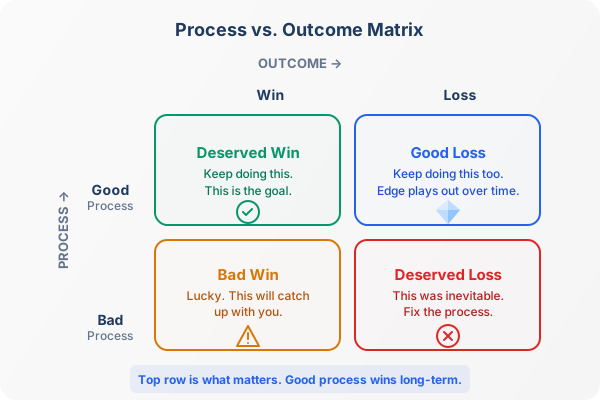
Tradris is built around this matrix. Your discipline score measures process quality. Your P&L measures outcome. Over time, good process and positive P&L converge -- but only if you have the patience to trust the process when individual trades go against you.
Principle 2: Journaling Is the Bridge Between Knowing and Doing
Every trader knows they should not revenge-trade. Every trader knows they should honor their stop loss. Every trader knows they should not chase.
And yet.
The gap between knowing and doing is the gap where money disappears. Journaling is the bridge across that gap, because it forces you to confront the moment where you chose to ignore what you knew.
When you write "I moved my stop because I was afraid of taking the loss," you cannot hide from it. It is there in your own words. And the next time you feel that fear, you will remember writing those words. That memory creates a micro-pause -- just enough friction to interrupt the impulse and give your rational mind a chance to speak.
This is not theory. This is the mechanism by which traders actually change. Not through reading books. Not through watching courses. Through writing down what they did, why they did it, and what it cost them.
Each journal entry adds a small increment of self-awareness. The compound effect is transformational. Early entries feel mechanical. Over weeks and months, patterns emerge that you could never see in real-time. That growing awareness is what turns knowledge into behavior change.

In Tradris, journaling is not a chore bolted onto the side. It is woven into the trade lifecycle. You journal when you enter (what is the plan?), when you manage (what are you feeling?), and when you exit (what happened vs. what you planned?). The journal is the trade. The trade is the journal.
Principle 3: Discipline Is Measurable
"I need to be more disciplined" is something every trader has said. But what does that actually mean? Without measurement, discipline is just a vague aspiration that feels good to say and impossible to act on.
Tradris makes discipline concrete through quantification. The 5-pillar scoring system breaks discipline into specific, observable behaviors:
From vague to concrete:
Instead of "be more disciplined," Tradris gives you a score like 72/100 with a breakdown -- Planning: 90, Risk: 85, Execution: 60, Emotional: 70, Review: 55. Now you know exactly what "more disciplined" means for you. Work on Execution and Review.

When discipline has a number, you can track it over time. You can set goals. You can see whether this week was better than last week. You can correlate discipline with performance and prove to yourself -- with your own data -- that disciplined trades outperform undisciplined ones.
The discipline score is not a grade from a teacher. It is a mirror. It reflects back what you actually did, not what you intended to do.
Principle 4: Your Data Works for You
Most traders accumulate trade data that sits in a spreadsheet and never gets analyzed. The data exists, but no intelligence comes back from it. Tradris closes that loop through TradrisAI -- structured behavioral insights derived from your trading history.
These are not generic market tips. They are observations about you:
-
"Your breakout strategy averages +1.8R across 47 trades. Your mean reversion strategy averages -0.3R across 23 trades." Now you know where your edge actually lives.
-
"Your disciplined trades average +1.2R. Your undisciplined trades average -0.7R." Now you have mathematical proof that discipline pays.
-
"You exited before your target on 62% of your winning trades." Now you can see the money you left on the table.
-
"After a 3+ win streak, your average position size increases 40% and your win rate drops from 58% to 31%." Now you can see the overconfidence pattern before it wrecks you.

The data feedback loop: You trade → Tradris records → TradrisAI analyzes → Insights are delivered → You adapt → You trade again. Your data goes in. Intelligence comes back. The more you trade, the smarter it gets.
The insight is only useful if it changes what you do next. That is why Tradris presents insights inside your journal -- right where you are already reflecting on your trades. Not buried in a dashboard you check once a month. Front and center, in the context of your daily trading practice.
Putting It All Together
Tradris is not a tool you use alongside your trading. It is a framework you trade within. The platform encodes the habits that profitable traders have spent years building through trial and error:
- Plan before you trade
- Risk what you can afford to lose
- Journal what you did and felt
- Score your discipline honestly
- Learn from the patterns in your data
- Improve your framework and do it again
None of these ideas are new. Traders have known this for decades. What is new is having a system that enforces the loop, measures the discipline, and returns the intelligence -- so that the knowing-doing gap finally closes.
The market does not care about your strategy. It cares about your consistency. Tradris builds that consistency, one scored trade at a time.
Ready to trade with discipline?
Start building your framework today. It takes 2 minutes to log your first trade.