Framework-First Trading
Why most traders lose money and how a framework-first approach with the discipline feedback loop transforms trading from impulsive to systematic.
The Problem Nobody Talks About
Here is the uncomfortable truth about trading: the vast majority of traders lose money. Not because the markets are rigged. Not because they lack intelligence. Not because they picked the wrong strategy off YouTube.
They lose because they have no system.
Think about what happens when a typical retail trader sits down at their screen:
- They see a stock moving and jump in on impulse
- They hold a losing position too long because "it will come back"
- They exit a winner too early because the fear of giving back profits is louder than the plan they never wrote down
- They size up after a winning streak because they feel invincible
- They revenge-trade after a loss because they need to "make it back"
None of these are strategy problems. They are discipline problems. And no indicator, no chart pattern, and no alert service will fix them.
The research is clear:
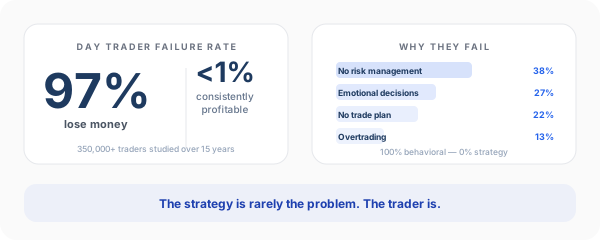
Sources: Barber, Lee, Liu & Odean (2014) · Chague et al. (2020) · DALBAR QAIB
The failure rate has nothing to do with strategy. It has everything to do with the trader.
Most traders spend 95% of their time looking for the perfect strategy and 5% working on themselves. That ratio needs to be inverted. The strategy is the smallest part of the equation. The system around it -- your rules, your risk limits, your journaling habit, your ability to follow the plan when your stomach is in knots -- that is what separates the few who make money from the many who do not.
Tradris exists to close that gap.
The Framework-First Approach
A trading framework is not a strategy. A strategy tells you when to buy and sell. A framework tells you how to trade -- period.
Your framework includes:
- Rules of engagement: Under what conditions do you trade at all?
- Risk parameters: How much can you lose per trade, per day, per week?
- Strategy playbook: Which setups do you take, and what are the exact criteria for each?
- Execution protocol: How do you enter, manage, and exit a position?
- Review process: How do you evaluate each trade -- win or lose -- and extract the lesson?
Trading with a framework means that before you ever place a trade, you already know what you are going to do in every scenario. The market gaps against you? You know your stop. The trade hits 50% of target and reverses? You know your trail rule. You take three losses in a row? You know your daily stop protocol.
Without a framework vs. with one:
| Situation | Without a Framework | With a Framework |
|---|---|---|
| Market moves | React on impulse | Check your rules |
| Feel fear | Panic exit | Consult the plan |
| See profit | Grab it immediately | Follow your trail rule |
| Take a loss | Revenge trade | Journal it |
| Win streak | Oversize the next trade | Same position size |
| Confusion | Freeze | Sit out |
Tradris enforces this structure without locking you into rigidity. You define your framework. Tradris helps you stick to it. When you deviate, you see it -- not as a judgment, but as data. Over time, that data shows you exactly where your discipline breaks down and exactly where your edge lives.
The goal is not to make you a robot. The goal is to make your good habits automatic so your mental energy goes toward reading the market, not fighting yourself.
The Discipline Feedback Loop
The core engine of Tradris is a six-stage feedback loop. Every trade you take flows through this cycle, and each stage feeds the next.
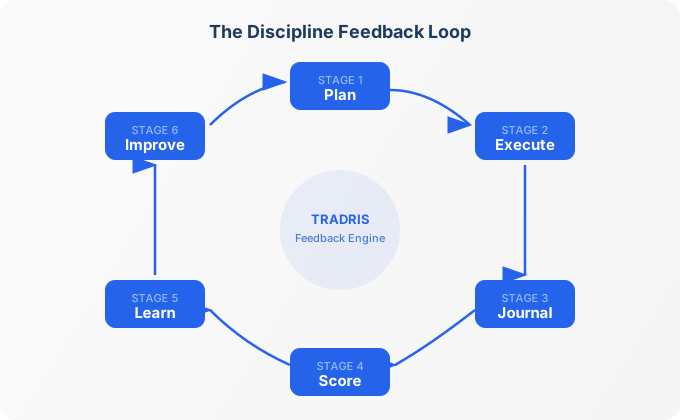
Here is how each stage works:
1. Plan
Before you enter any trade, you define the setup. What strategy are you using? What is your entry trigger? Where is your stop loss? What is your target? What is your position size based on your risk rules?
In Tradris, this happens when you log a trade. You select the strategy from your playbook, set your entry and stop, and the platform calculates your risk-reward ratio and validates it against your portfolio risk limits.
This is not paperwork. This is the moment you commit to a plan. Once it is written down, you have something to hold yourself accountable to.
2. Execute
You take the trade in your broker. The execution itself happens outside Tradris -- we are not a broker. But Tradris tracks whether your actual execution matched your plan. Did you enter where you said you would? Did you take the size you planned? Did you honor your stop?
3. Journal
After the trade is done -- or while it is still active -- you write about it. Not a novel. Just the key observations:
- What did you see in the market that triggered this trade?
- How did you feel during the trade? Confident? Anxious? Reckless?
- Did you follow your rules, or did you deviate? If you deviated, why?
- What would you do differently next time?
Tradris supports multiple journal entry types: trade analysis, emotional check-ins, lessons learned, and general observations. You can also attach YouTube video breakdowns and chart screenshots. The goal is to capture the full picture -- not just the numbers, but the psychology behind the numbers.
4. Score
This is where Tradris does something no spreadsheet can. Every trade gets a discipline score based on the 5-pillar system:
| Pillar | What It Measures |
|---|---|
| Pre-Trade Planning | Did you define entry, stop, and target before executing? |
| Risk Compliance | Did you follow your position sizing and risk rules? |
| Execution Fidelity | Did your actual trade match your plan? Entry, exit, management? |
| Emotional Awareness | Did you journal your emotional state? Were you aware of your biases? |
| Post-Trade Review | Did you review the trade and extract a lesson, win or lose? |
Your discipline score is not your P&L. A trade can lose money and still score high on discipline -- because you followed your system perfectly and the market just did not cooperate. That is a good loss. Conversely, a trade can make money with a terrible discipline score -- you YOLOed, ignored your stops, and got lucky. That is a bad win.
The score forces you to separate process from outcome, which is the single most important mental shift a trader can make.
5. Learn
Over time, your scored trades accumulate into a dataset that reveals patterns you cannot see in real-time. TradrisAI analyzes this data and surfaces insights:
- Which of your strategies actually makes money over time?
- Do disciplined trades perform better than undisciplined ones? (Spoiler: yes.)
- Are you exiting winners too early?
- Do you increase risk after winning streaks?
- Is your discipline trending up or down?
These are not generic tips. They are derived from your trading data, your behavior, your patterns.
6. Improve
Armed with insight, you refine your framework. Maybe you drop a strategy that looked good but never delivered. Maybe you tighten your risk rules after seeing that you blow up when you size above 2%. Maybe you add a mandatory 10-minute wait rule after a loss, because the data shows your revenge trades have a 78% loss rate.
Then you take the next trade -- with an updated plan. And the loop starts again.
What Makes Tradris Different
There are plenty of tools that let you log trades. Spreadsheets. Journals. Apps with fancy charts. So why does Tradris exist?
Because logging trades is not the hard part. Changing your behavior is the hard part. And that requires more than a blank text field and a P&L column.
| Capability | Excel | Basic Journal App | Tradris |
|---|---|---|---|
| Log trades | Yes | Yes | Yes |
| Track P&L | Yes | Yes | Yes |
| Risk validation | No | Some | Yes |
| Discipline score | No | No | Yes |
| Behavioral insights | No | No | Yes |
| Strategy analytics | Manual | No | Automatic |
| Accountability system | None | None | Built-in |
| Emotional tracking | No | Some | Structured |
| AI analysis | No | Some | Yes |
| Framework enforcement | No | No | Yes |
Tradris is not a passive record-keeper. It is an accountability system that:
- Watches your behavior -- tracks whether you follow your own rules
- Measures your discipline -- quantifies something traders usually leave vague
- Returns intelligence -- surfaces patterns from your data that you would never spot manually
- Creates consequences -- not punishments, but visibility. When you see your discipline score drop after three days of impulsive trading, that number holds up a mirror
The goal is to make your trading data work for you instead of sitting in a spreadsheet collecting dust.
Ready to trade with discipline?
Start building your framework today. It takes 2 minutes to log your first trade.