Trade Lifecycle Stages
Every trade moves through four stages: Setup, Entry, Exit, and Review. Learn what happens at each stage and why this structure prevents impulsive trading.
Every trade in Tradris moves through four distinct stages. This is not arbitrary structure -- it mirrors the way disciplined traders actually think about their trades. The lifecycle forces you to separate planning from execution from reflection, which is where most traders lose their edge.
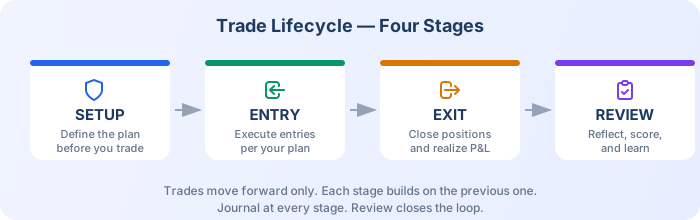
Trades always move forward through this pipeline. You cannot move a trade backward from EXIT to ENTRY, or from REVIEW to EXIT. This is intentional -- it prevents you from retroactively editing your plan to match what actually happened, which would defeat the purpose of honest self-assessment.
A trade can sit at any stage for as long as you need. A SETUP that never gets entered is a valid outcome. A trade that stays in ENTRY for weeks while you manage a swing position is normal. There is no timer.
Stage 1: SETUP -- Plan the Trade Before You Enter
Icon: Shield (blue)
The SETUP stage is where you define your thesis and risk parameters before committing any capital. When you create a trade in SETUP, its status is set to IDEA -- it is a plan, not yet a live position.
This is the most important stage for building discipline. The entire point is to force you to answer the question: "What is my plan?" before your finger hits the buy button.
What you define at SETUP
| Field | Description | Required |
|---|---|---|
| Instrument/Symbol | What you are trading (e.g., RELIANCE, NIFTY FUT) | Yes |
| Direction | LONG or SHORT | Yes |
| Strategy | Which of your defined strategies this trade follows | No |
| Planned Entry Price | The price level you intend to enter at | No |
| Target Price | Your profit target | No |
| Stop Loss Price | The price at which you will exit if wrong | No |
| Risk Amount | How much capital you are willing to lose on this trade | No |
| Trade Type | EQUITY or FUTURES | No |
None of the price fields are required because some traders prefer to define their levels on charts and enter quickly. But the more you fill in here, the higher your discipline score will be later.
Example
You spot a breakout pattern forming on TATA MOTORS. Before entering, you create a SETUP:
- Symbol: TATAMOTORS
- Direction: LONG
- Strategy: Breakout Pullback
- Planned Entry: 985
- Target: 1,050
- Stop Loss: 960
- Risk Amount: 5,000
The trade now exists in your journal as an IDEA. You have a plan. Now you wait for execution conditions.
Stage 2: ENTRY -- Execute Positions
Icon: Entry arrow (blue)
When you move to the ENTRY stage, you are recording your actual execution. The trade status changes from IDEA to ACTIVE once you add a real fill. This is where the market meets your plan.
Staggered entries
Tradris supports adding multiple entry positions to a single trade. You do not have to enter your entire position at once. Each entry position records:
- Quantity: How many shares/lots in this tranche
- Price: The actual execution price
- Date: When this tranche was executed
The system automatically calculates your weighted average entry price and total position size across all entry positions.
Staggered entry example
Continuing the TATA MOTORS trade:
| Position | Shares | Price | Date | Note |
|---|---|---|---|---|
| Entry 1 | 50 | 982 | March 3 | Initial entry |
| Entry 2 | 30 | 978 | March 5 | Added on pullback |
| Entry 3 | 20 | 990 | March 8 | Breakout confirmed |
| Total | 100 | 983.4 avg | Weighted average |
You planned to enter at 985. Your actual average was 983.4. This deviation from plan is captured automatically and feeds into your discipline analysis later.
Journal prompt at ENTRY
When you add your first entry position, Tradris prompts you to journal:
"Did you execute this trade as planned?"
This is not optional nagging -- it is the first checkpoint in your discipline loop. Writing a sentence or two about whether you followed your plan (or deviated and why) builds the data that TradrisAI uses to identify your behavioral patterns.
Stage 3: EXIT -- Close Positions
Icon: Exit arrow (red)
The EXIT stage is where you record closing your position, either partially or fully. When all shares/lots are exited, the trade status automatically changes to CLOSED.
Partial and full exits
Just like entries, you can add multiple exit positions:
- Partial exit: Close some of your position. The trade remains ACTIVE.
- Full exit: Close the remaining position. The trade moves to CLOSED.
P&L calculation
Realized P&L is calculated when exit positions are added. For a LONG trade:
Realized P&L = (Exit Price - Entry Price) x Quantity Exited
For SHORT trades, the formula is reversed. When you have staggered entries and exits, the system uses the weighted averages to compute your P&L accurately.
Exit example
Continuing the TATA MOTORS trade (100 shares, avg entry 983.4):
| Position | Shares | Price | Date | Note |
|---|---|---|---|---|
| Exit 1 | 50 | 1,030 | March 15 | Partial profit booking |
| Exit 2 | 50 | 1,045 | March 20 | Remaining position closed |
Realized P&L: (1,030 - 983.4) x 50 + (1,045 - 983.4) x 50 = 2,330 + 3,080 = 5,410 profit
You had a target of 1,050. You exited your second tranche at 1,045 -- close but not quite. That gap between plan and execution is exactly what you will reflect on in the REVIEW stage.
Journal prompt at EXIT
When you add an exit position, Tradris prompts:
"Regardless of the result, how did you trade?"
This prompt is deliberately focused on process, not outcome. Whether you made money or lost money is already captured in the numbers. The journal entry is about your decision-making quality.
Stage 4: REVIEW -- Reflect on the Trade
Icon: Clipboard with checkmark
The REVIEW stage is where you step back and classify the trade honestly. This is the stage that separates journaling from actual learning.
The Outcome Matrix
Every closed trade falls into one of four quadrants based on two dimensions: the quality of your process and the financial outcome.
| Win | Loss | |
|---|---|---|
| Good Process | Good Win -- You followed your plan and it worked. | Good Loss -- You followed your plan and the market went against you. |
| Bad Process | Bad Win -- You broke your rules but got lucky. | Bad Loss -- You broke your rules and lost money. |
This matrix is the core of Tradris's philosophy. Here is why each quadrant matters:
Good Win -- The ideal outcome. You had a plan, you followed it, and the market rewarded you. This is the trade to replicate.
Good Loss -- Still a success in terms of discipline. You followed your plan and your stop loss was hit. The market did not cooperate, but your process was sound. Over time, good losses are what keep you in the game.
Bad Win -- The most dangerous outcome. You broke your rules -- maybe you moved your stop loss, entered impulsively, or oversized your position -- but you made money anyway. This reinforces bad habits. Tradris flags these so you recognize that profit does not validate poor discipline.
Bad Loss -- The wake-up call. You deviated from your plan and lost money. The goal is to make these rare by catching Bad Wins before they turn into Bad Losses.
Journal prompt at REVIEW
Before you can tag the outcome, Tradris prompts:
"Before you classify this trade, capture your thoughts."
Writing your reflection before tagging forces you to think through the trade honestly instead of just clicking a button.
Discipline scoring
The REVIEW stage is where your trade discipline score is finalized. The score accounts for:
- Whether you journaled at each lifecycle stage
- Whether you tagged an outcome classification
- How thoroughly you documented your decision-making
Trades with higher discipline scores contribute more positively to your overall trader profile, regardless of whether they were winners or losers.
Fields Available at Each Stage
The following table shows which fields are relevant and editable at each lifecycle stage:
| Field | SETUP | ENTRY | EXIT | REVIEW |
|---|---|---|---|---|
| Symbol | Set | View | View | View |
| Direction (Long/Short) | Set | View | View | View |
| Strategy | Set | Edit | View | View |
| Trade Type | Set | Edit | View | View |
| Planned Entry Price | Set | View | View | View |
| Target Price | Set | Edit | View | View |
| Stop Loss Price | Set | Edit | Edit | View |
| Risk Amount | Set | Edit | View | View |
| Entry Positions | -- | Add | View | View |
| Exit Positions | -- | -- | Add | View |
| Exit Reason | -- | -- | Set | View |
| Outcome Tag | -- | -- | -- | Set |
| Chart | Set | Edit | Edit | View |
| Journal Entries | Add | Add | Add | Add |
Set = First defined at this stage. Edit = Can be modified. Add = New items can be added. View = Visible but not editable. -- = Not applicable at this stage.
Note that journal entries can be added at any stage. You can journal about your SETUP rationale, your ENTRY execution, your EXIT decision, and your REVIEW reflection. The more you journal, the more data TradrisAI has to surface patterns in your trading behavior.
Staggered Entry and Exit -- Full Example
Here is a complete lifecycle walkthrough for a futures trade to illustrate staggered positions across all four stages.
SETUP
You identify a bullish flag pattern on NIFTY futures.
- Symbol: NIFTY FUT (March expiry)
- Direction: LONG
- Strategy: Flag Breakout
- Planned Entry: 22,500
- Target: 22,800
- Stop Loss: 22,350
- Risk Amount: 15,000
- Lot Size: 25
Trade status: IDEA
ENTRY
The breakout triggers. You enter in two tranches to manage your exposure:
| Position | Lots | Units | Price | Date | Note |
|---|---|---|---|---|---|
| Entry 1 | 2 | 50 | 22,510 | March 10 | Breakout candle close |
| Entry 2 | 1 | 25 | 22,480 | March 11 | Retest of breakout level |
| Total | 3 | 75 | 22,500 avg | Weighted average |
Your journal entry: "Entered 2 lots on breakout candle close. Added 1 lot on retest. Execution matches plan. Slightly better avg than planned."
Trade status: ACTIVE
EXIT
NIFTY reaches your target zone but you decide to scale out:
| Position | Lots | Units | Price | Date | Note |
|---|---|---|---|---|---|
| Exit 1 | 2 | 50 | 22,780 | March 14 | Near target, booking 2/3 |
| Exit 2 | 1 | 25 | 22,700 | March 15 | Trailing stop hit |
Realized P&L: (22,780 - 22,500) x 50 + (22,700 - 22,500) x 25 = 14,000 + 5,000 = 19,000 profit
Your journal entry: "Booked partial profits at 22,780 to lock in gains. Trailed stop on remaining lot but got stopped at 22,700 on a pullback. Could have held for full target but capital preservation was the priority."
Trade status: CLOSED
REVIEW
You classify this trade as a Good Win:
- You followed your strategy rules for entry
- You exited near your target with a disciplined partial booking approach
- The second lot exited below target, but within your risk management framework
- Total P&L of 19,000 exceeded your risk amount of 15,000 (positive R-multiple)
Your journal entry: "Clean execution of the flag breakout strategy. Staggered exit worked well for risk management even though I left some money on the table. The trailing stop on the last lot was the right call -- I would rather protect profits than chase the last 100 points."
Key Takeaways
-
Every trade needs a plan. The SETUP stage exists to make sure you never enter a position without knowing your thesis, target, and risk.
-
Execution is tracked against the plan. The ENTRY and EXIT stages capture what actually happened, so you can compare reality against intention.
-
Process matters more than outcome. The 2x2 outcome matrix in REVIEW forces you to evaluate your discipline separately from your P&L.
-
Staggered positions are first-class. You do not have to enter or exit all at once. Multiple entry and exit positions are supported and P&L is calculated correctly across tranches.
-
Journal prompts at every transition. Each stage change triggers a contextual prompt that encourages you to document your thinking in the moment, not retroactively.
-
Forward-only movement. You cannot move backward through stages, which prevents after-the-fact rationalization and keeps your trade journal honest.
Ready to trade with discipline?
Start building your framework today. It takes 2 minutes to log your first trade.